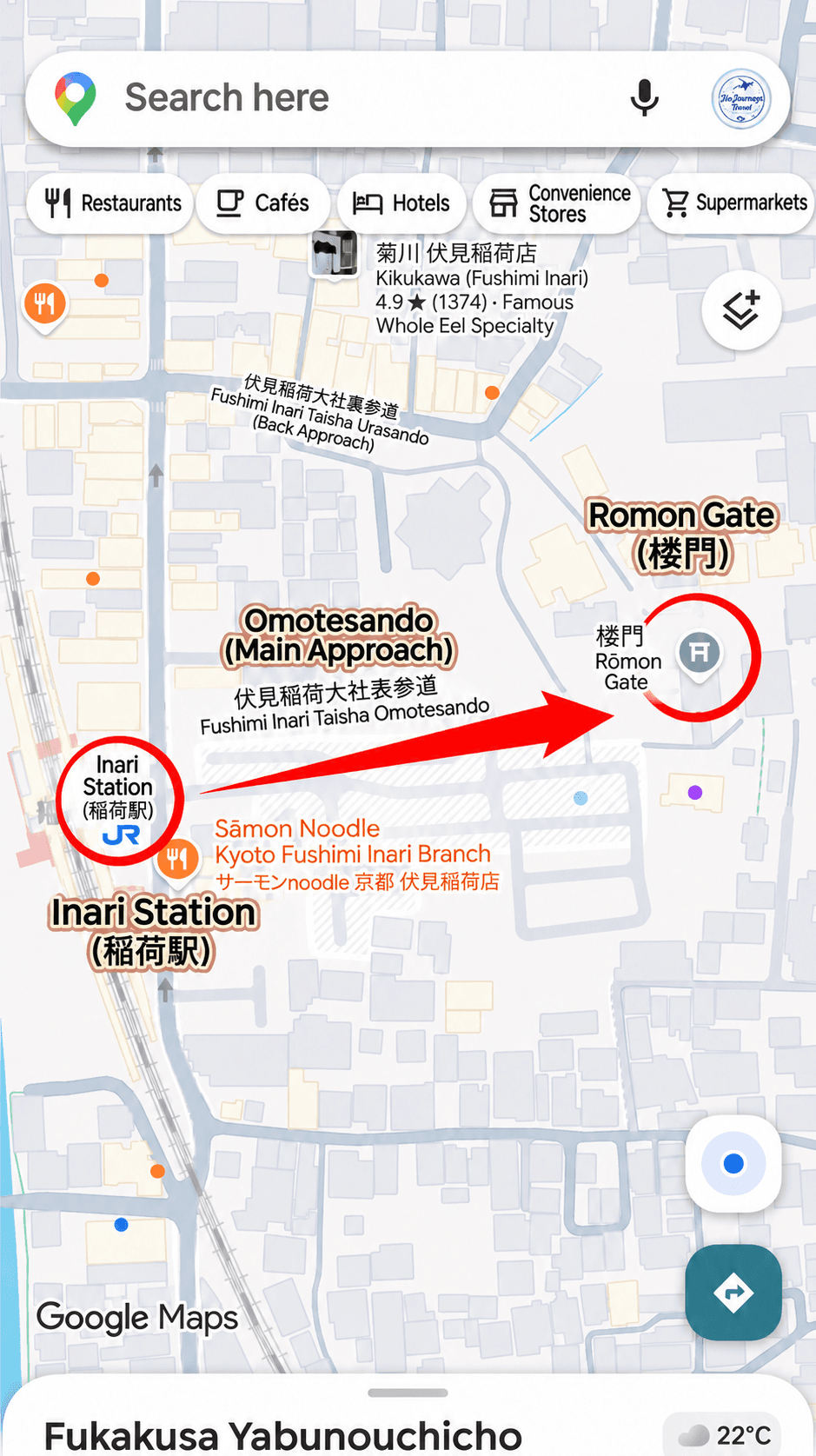
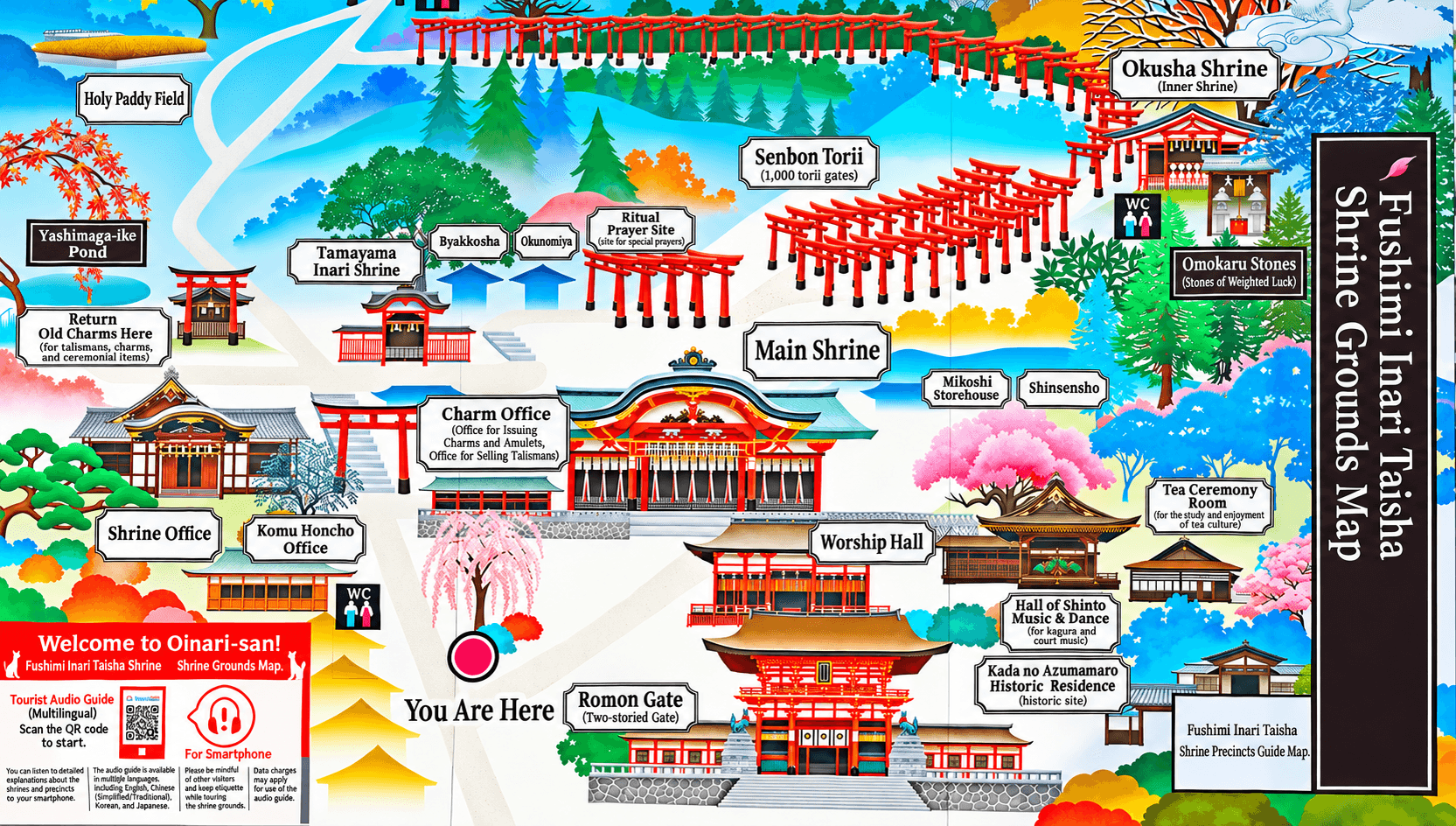
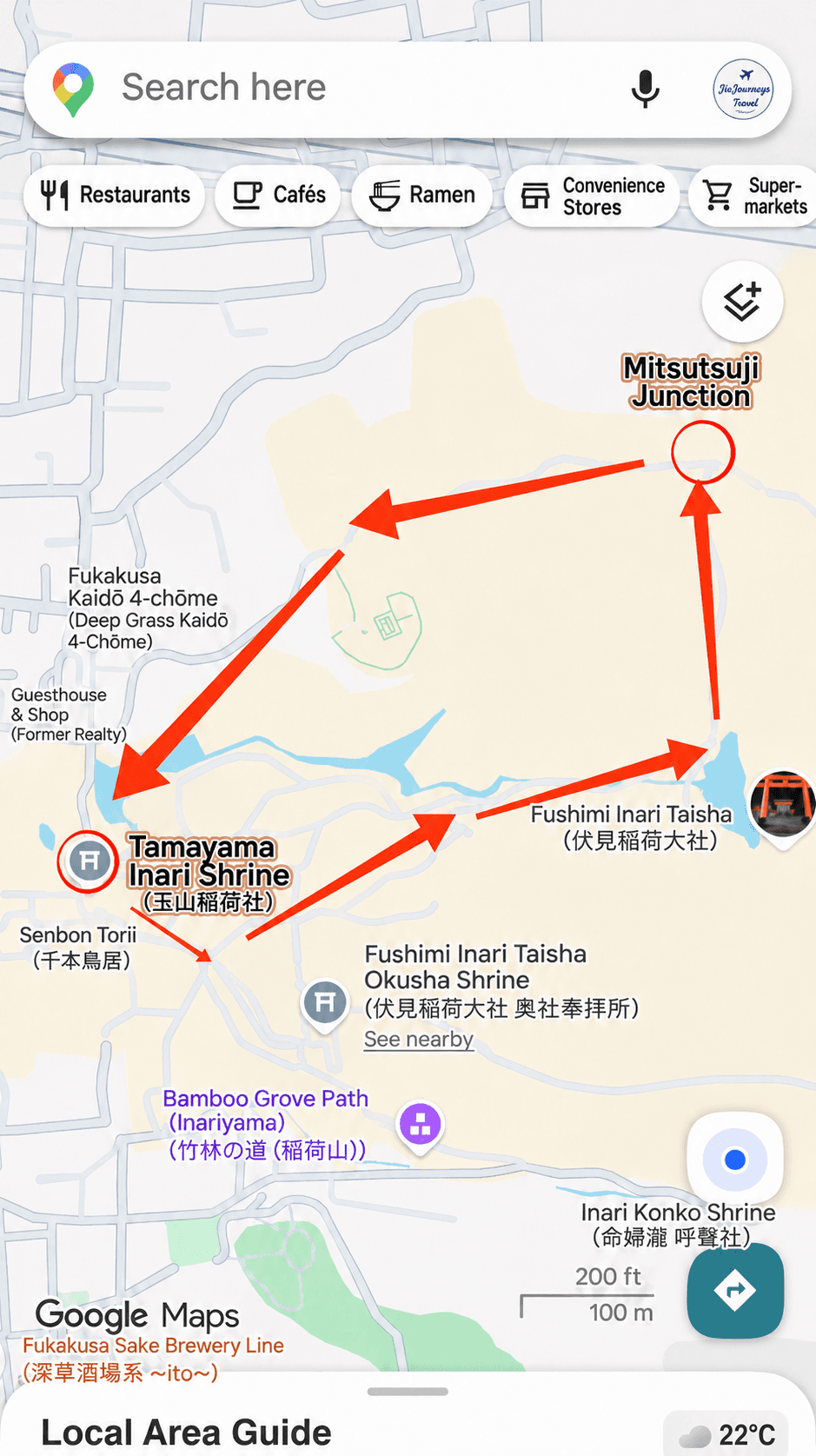
You do not need to push for the summit on a first visit. From JR Inari Station, follow the main approach, Romon Gate, main sanctuary, Tamayama Inari Shrine and Senbon Torii. For a longer walk, loop back from Mitsutsuji, passing small shrines along the route.
About two stops and five minutes from Kyoto Station on the JR Nara Line; the main approach starts outside the station.
Visit the sanctuary first, then walk towards Tamayama Inari Shrine and the Senbon Torii.
Descend along the other mountain path to near Tamayama Inari Shrine; no summit climb is needed.
Includes worship, photos and the short loop. Allow extra flexibility when it is crowded.
For a first visit, taking JR to Inari Station is the simplest option. Fushimi Inari Taisha's official website places JR Inari Station on the Nara Line beside the shrine, about two stops and five minutes from Kyoto Station. After leaving the station, follow the main approach straight ahead rather than entering side lanes. The vermilion Romon Gate will come into view.

If Keihan fits your itinerary better, walk about five minutes east from Fushimi-inari Station on the Keihan Main Line. Nearby parking fills up, so the official guidance also recommends public transport. Before setting out, check Fushimi Inari Taisha Access Information.
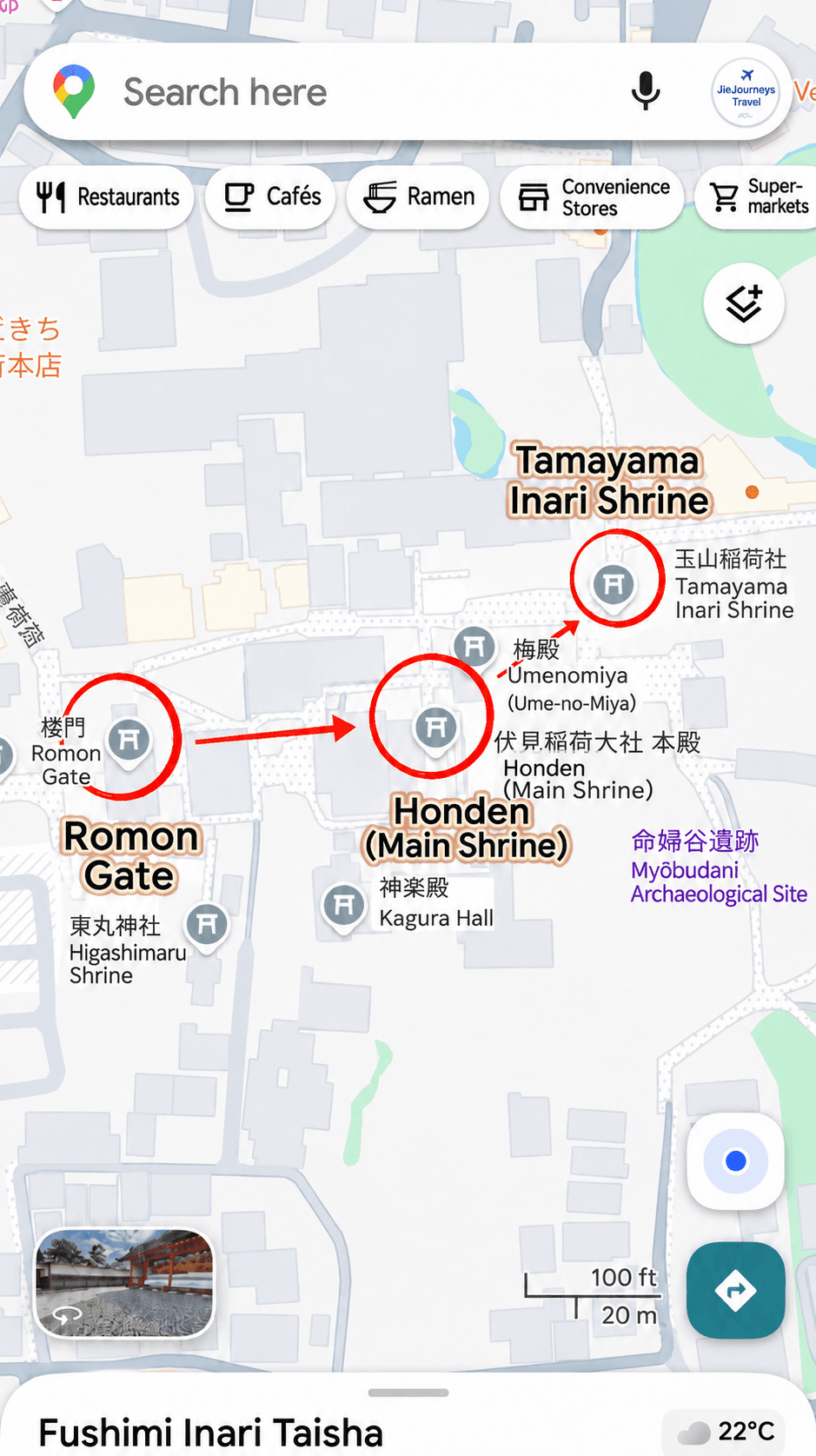
After Romon Gate, visit the main sanctuary before heading towards the mountain. You will pass Tamayama Inari Shrine; follow on-site signs towards the Senbon Torii. Beyond the gates lie Okusha Hohaisho and more mountain trails, so reaching the summit is not necessary just for the classic photographs.

Romon Gate, the main sanctuary and the Senbon Torii are on the lower part of the route. The pilgrimage paths continue higher up Mount Inari. According to the official website, around 10,000 large and small torii now line the mountain paths; the Senbon Torii is their best-known, most densely packed section.

The Senbon Torii is more than a photo installation. The shrine's official website explains that worshippers have dedicated gates in prayer and gratitude since the Edo period, creating today's landscape. For worship locations and the gates' origins, see Fushimi Inari Taisha Grounds Map and Official Senbon Torii Introduction.
For a longer walk without climbing to the summit, use Mitsutsuji as your turnaround point. The supplied route joins the mountain path near Tamayama Inari Shrine, climbing past torii and small shrines. Allow about 30 minutes to the marked three-way junction, then descend by the other path, allowing around another 30 minutes back to the main sanctuary area.

| Route | Suggested time | Best for |
|---|---|---|
| Romon Gate, Main Sanctuary & Lower Senbon Torii | About 30-60 Minutes | First visits focused on worship and photos |
| Continue to Mitsutsuji and Loop Back | About 1-1.5 Hours | For more torii, small shrines and forest trails |
| Continue Up Mount Inari | Set Aside More Time | For visitors with enough energy, comfortable shoes and willingness to climb more stairs |
These times are planning estimates, not fixed walking records. Crowds, photo stops, worship and fitness all affect the actual duration. If you are tired at Mitsutsuji, follow the mapped loop downhill rather than pushing farther uphill on impulse.
Visit Fushimi Inari in the morning, then continue towards Kyoto Station, the city centre or Uji according to your hotel location. Use the area guide first to reduce unnecessary backtracking.
JR Inari Station on the Nara Line is right beside Fushimi Inari Taisha. Follow the main approach from the station to Romon Gate. It is also about a five-minute walk from Fushimi-inari Station on the Keihan Main Line.
No. Walk from Romon Gate and the main sanctuary towards the Senbon Torii and Okusha Hohaisho to see the best-known dense rows of gates. For more forest and small shrines, extend to Mitsutsuji and loop back.
Allow about 30-60 minutes for Romon Gate, the main sanctuary and the Senbon Torii. For the route in this article to Mitsutsuji and back, allow at least 1-1.5 hours. Photos, crowds and your fitness will affect the time needed.
No. The junction shown on the map is Mitsutsuji on the mountain trail, the turnaround point of this shorter loop. Reaching Mount Inari's summit requires a longer climb with more uphill paths and stairs.
It is often busy at peak times. For a more relaxed visit and photos, prioritise the morning and check Kyoto's official congestion forecast for Fushimi before setting out. Leave room for others to pass when taking photos on narrow paths.