On a first visit, the main source of confusion is that Ninomaru Palace and Honmaru Palace require separate tickets. This guide explains a quick one-hour route, a recommended two-hour route and a full 2.5-hour route, along with Karamon Gate, the palaces, gardens and castle keep remains.
See Ninomaru Palace, Honmaru, the castle keep remains and Seiryu-en Garden.
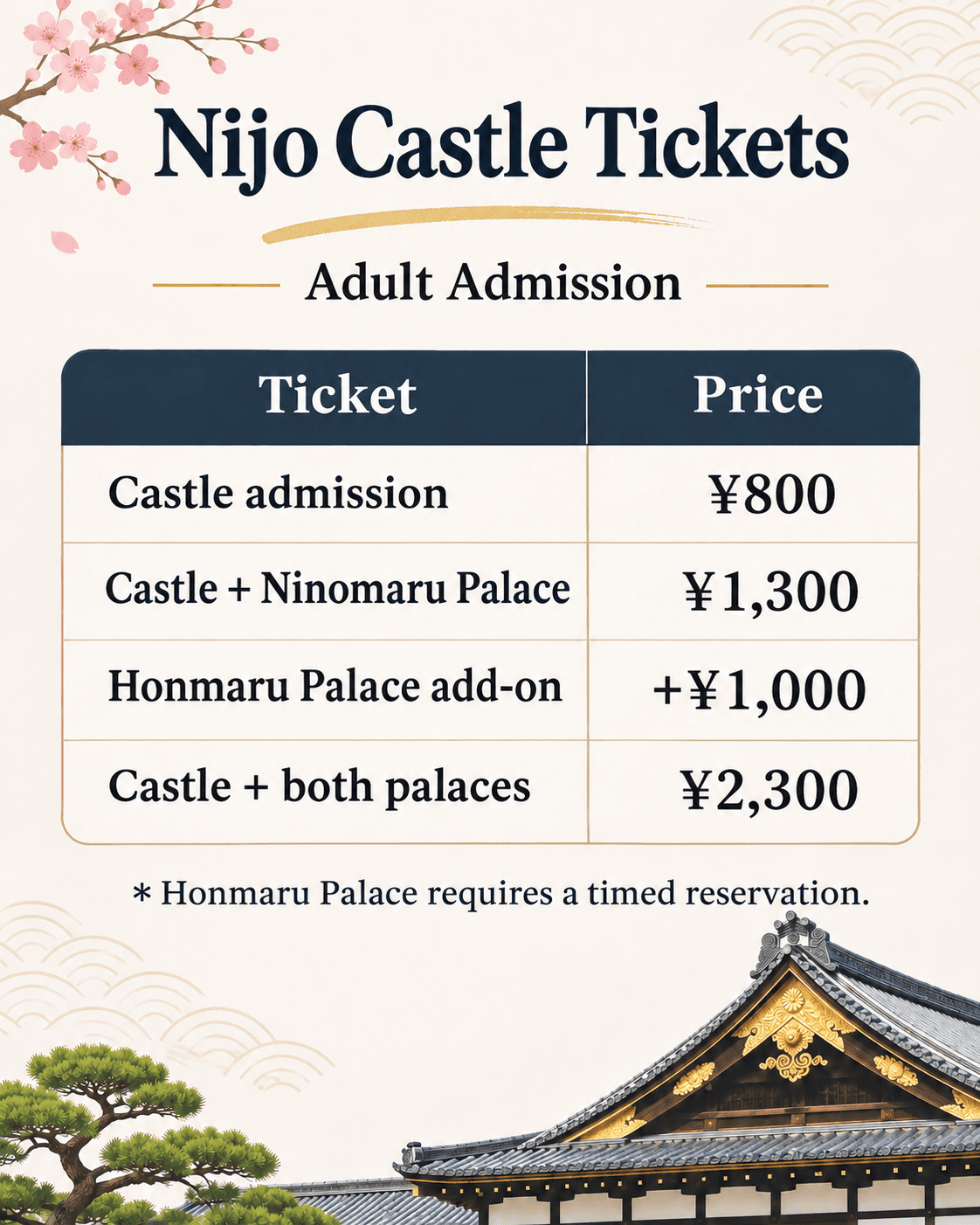
Includes castle entry and Ninomaru Palace; Honmaru Palace costs an additional 1,000 yen.
Last castle entry is at 16:00; each palace has its own admission cutoff.
From Kyoto Station, change at Karasuma Oike for the Tozai Line.
Tokugawa Ieyasu built Nijo Castle in 1603 to protect Kyoto Imperial Palace and accommodate the shogun during visits to Kyoto. In 1867, Tokugawa Yoshinobu announced his intention to restore political power to the Emperor at Ninomaru Palace. In 1994, Nijo Castle was inscribed on the World Heritage List as part of the Historic Monuments of Ancient Kyoto.
For a first visit, focus on the ornate Karamon Gate, National Treasure Ninomaru Palace, Ninomaru Garden, Honmaru Area & Castle Keep Remains rather than looking for a towering keep. The castle grounds are extensive, and without a route you may realise halfway through that you have not allowed enough time. For history and cultural property information, see Nijo Castle's Official Overview.

| Tickets | Adults | Reservation Required? | Best for |
|---|---|---|---|
| Castle Entry Only | 800 Yen | No | Outdoor gardens and castle grounds only |
| Castle Entry + Ninomaru Palace | 1,300 Yen | No timed slot required | Recommended for a first visit |
| Honmaru Palace | Additional 1,000 Yen | Timed reservation | For visiting both palaces in full |
| Painting Gallery | Additional 100 Yen | Open during exhibition periods | For close views of original wall and screen paintings |

| Ticket | Price (JPY) |
|---|---|
| Castle admission | ¥800 |
| Castle admission + Ninomaru Palace | ¥1,300 |
| Honmaru Palace add-on | +¥1,000 |
| Castle + both palaces | ¥2,300 |
Honmaru Palace requires a reservation for a specified time. Separate exhibition-gallery fees may apply.
The simplest way to avoid buying the wrong ticket: Start with the 1,300-yen castle entry plus Ninomaru Palace ticket. If you want to enter Honmaru Palace, add its separate timed ticket. Adults visiting both palaces pay 2,300 yen in total.
Ninomaru Palace tickets are available on site or online without a designated entry time. Honmaru Palace has capacity controls, and official online tickets go on sale 30 days before the visit. Purchases cannot be changed, cancelled or refunded. Walking from Higashi Ote-mon to Honmaru Palace takes about 15-20 minutes; the official guidance requires entering the castle at least 20 minutes before your reservation. Consult and .
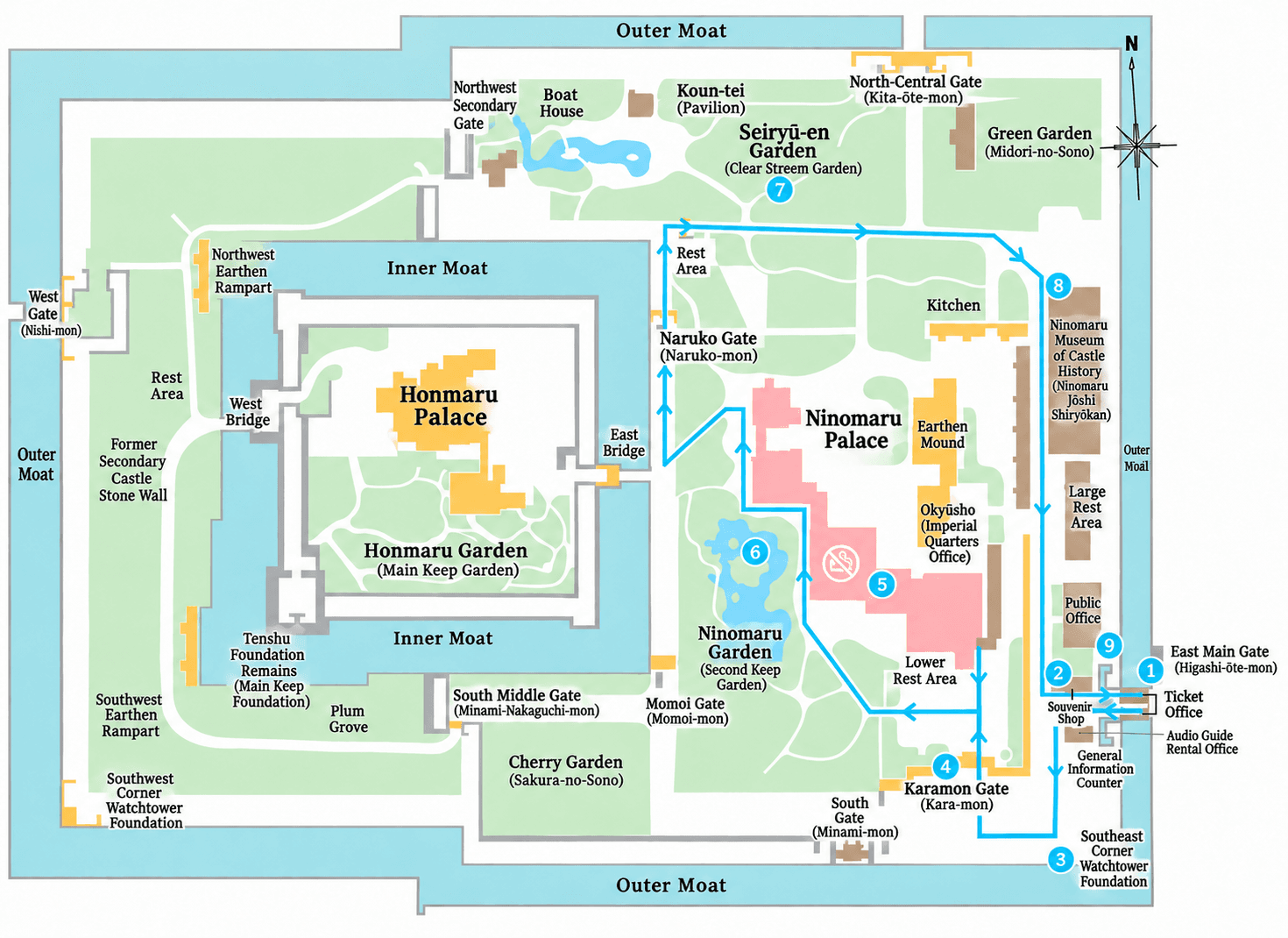
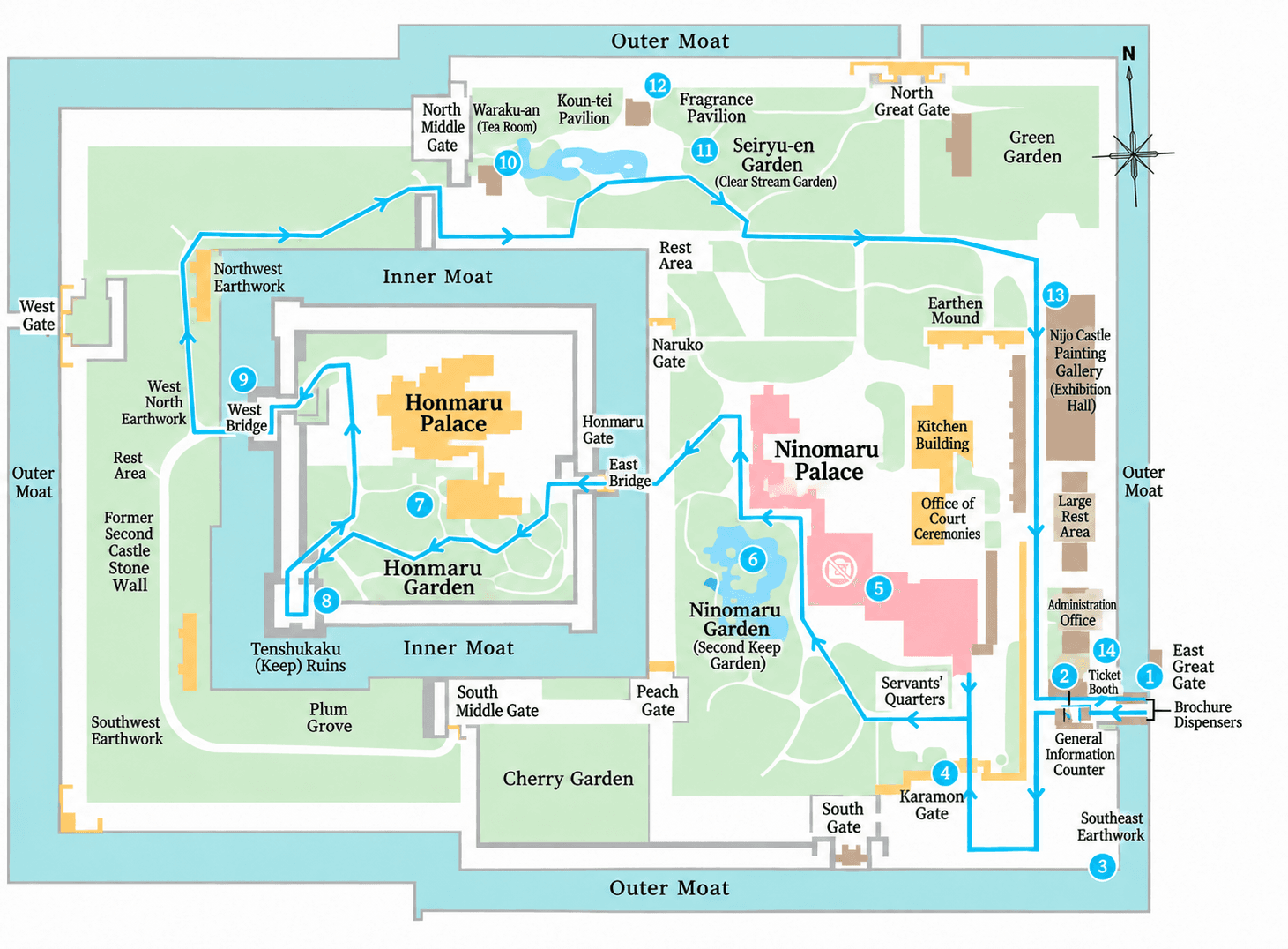
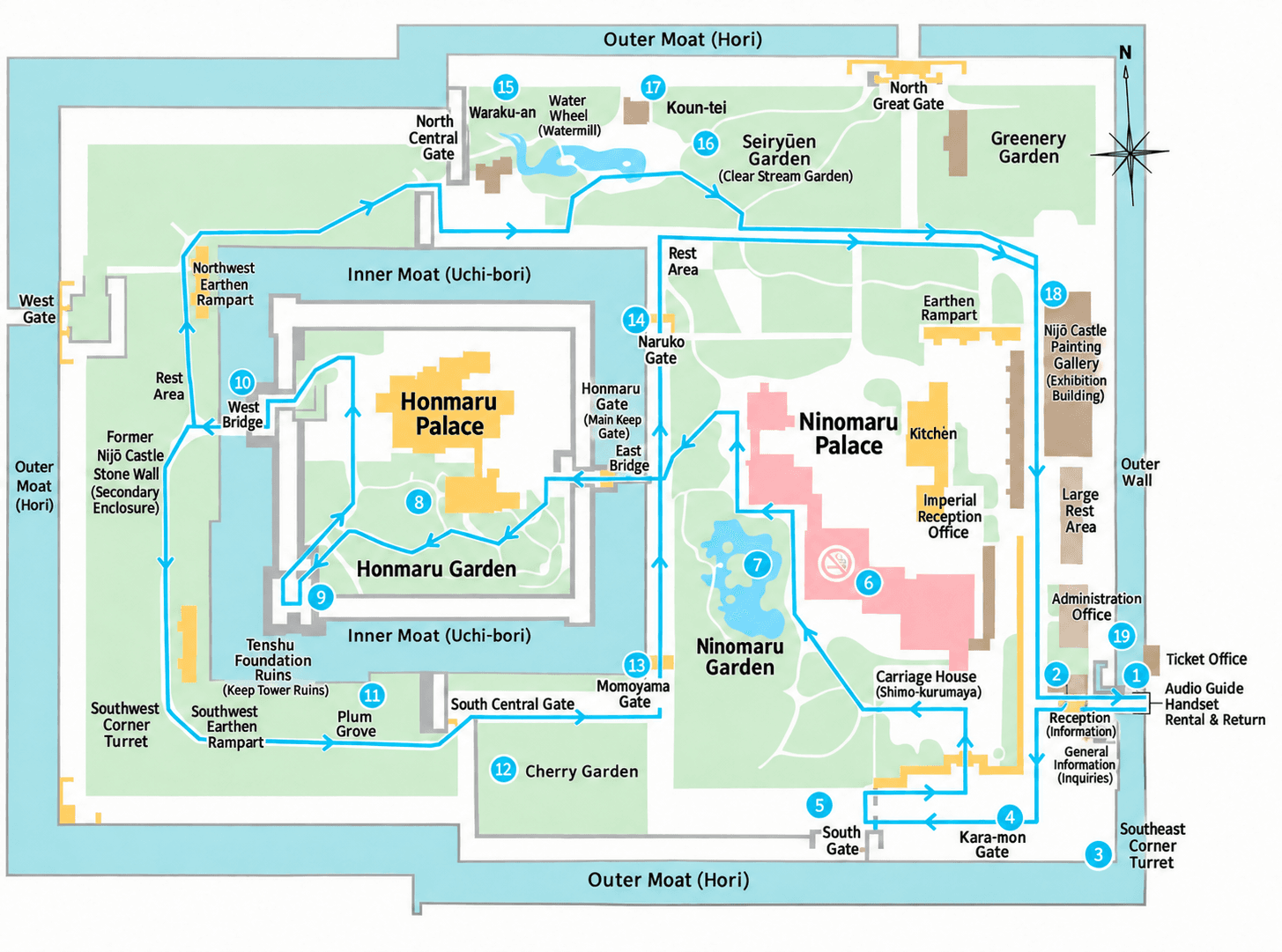
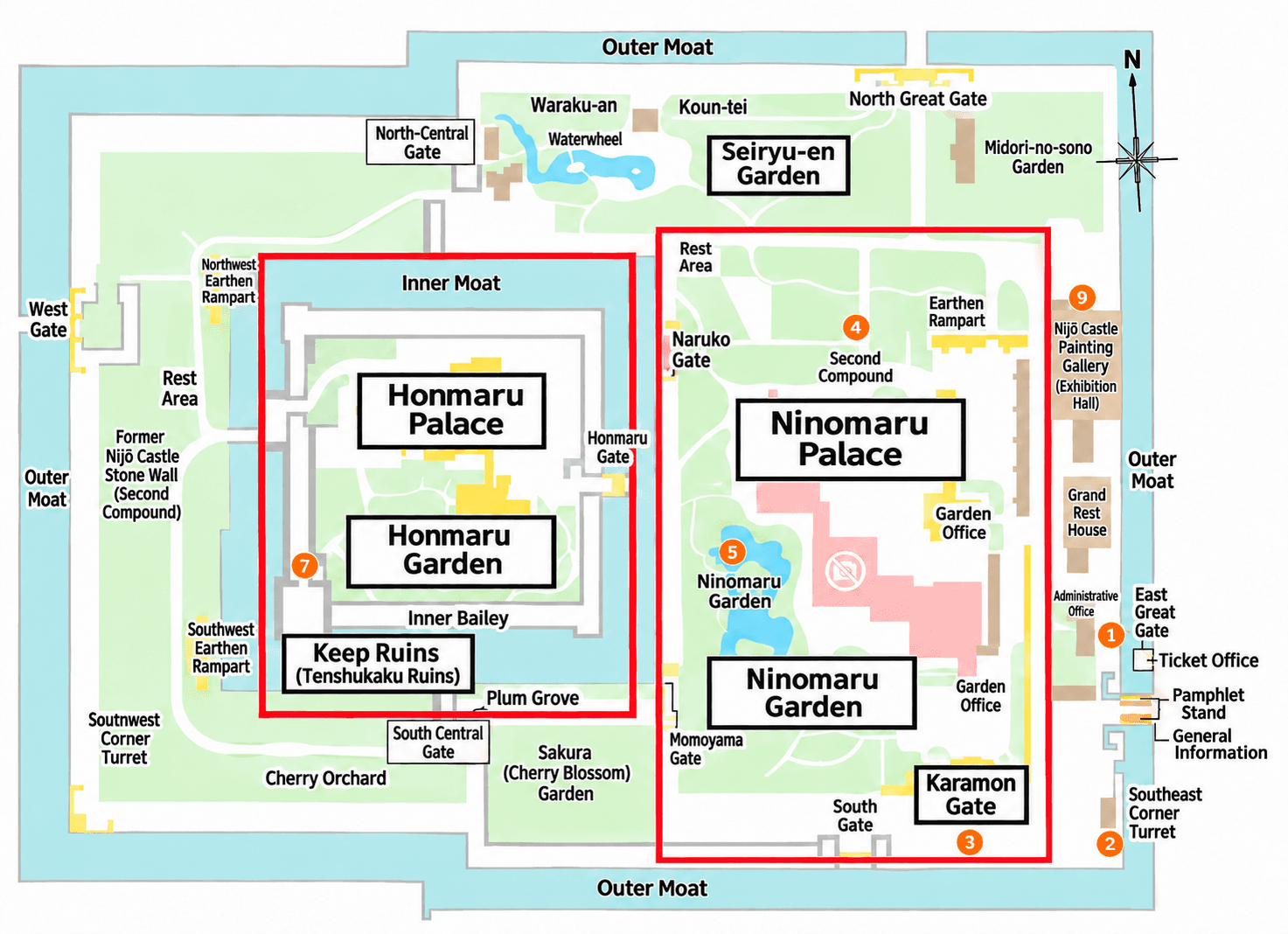
Nijo Castle offers three official model routes based on visit duration. The three maps below mark directions and numbered stops. Times include normal walking and sightseeing, but allow extra buffer for peak-season queues, leisurely photos or a Honmaru Palace reservation.
Higashi Ote-mon > Southeast Corner Watchtower > Karamon Gate > Ninomaru Palace > Ninomaru Garden > Seiryu-en > Painting Gallery > Higashi Ote-mon

Quick route + Honmaru Garden, Honmaru Palace exterior, castle keep remains and route north of the West Bridge. This covers the castle's two most important areas without circling the entire southwestern grounds.

Recommended route + South Gate, plum grove, cherry orchard, Momoyama-mon, Naruko-mon and route south of the West Bridge. During the plum season, roughly mid-February to late March, and cherry blossom season, roughly late March to early April, the official guidance also recommends heading south from the castle keep remains to see the plum grove and cherry orchard.

The three routes and seasonal alternatives are based on Nijo Castle's Official Model Routes.
Most visitors enter from the eastern ticket office. After passing Higashi Ote-mon, view the moat and Southeast Corner Watchtower. This is the starting point for understanding the defensive layout and photographing the whole gate exterior.
Known for carvings, colourful decoration and gold-leaf details, Karamon is one of Nijo Castle's signature exteriors. Before entering Ninomaru Palace, look closely at the plants, animals and auspicious motifs on the gate.
The National Treasure Ninomaru Palace comprises six buildings connected diagonally, with 33 rooms and more than 800 tatami mats. Kano-school wall and screen paintings project the shogun's authority. The route also crosses the sounding nightingale corridors. Photography and video are prohibited inside, and shoes must be removed.
Ninomaru Garden combines a pond, Horai Island, Crane Island and Turtle Island. Remodelled for Emperor Go-Mizunoo's visit, it was designed to be viewed from the Ohiroma, Kuro-shoin and the imperial-visit palace that stood here at the time.
The surviving Honmaru Palace is not the original early-Edo building. It was moved here in 1893-1894 from the Katsura-no-miya Palace north of Kyoto Imperial Palace, and reopened after restoration in 2024. Entering requires a separate ticket and timed reservation. General castle admission still allows the Honmaru Garden and surrounding routes.
The original five-storey keep burned down after a lightning strike in 1750 and was never rebuilt. Its stone base survives. Climb the remains for views of Honmaru Palace, Honmaru Garden and Kyoto, one of the route's few elevated perspectives on the castle layout.
Seiryu-en combines Japanese and Western garden scenery and suits a rest on the return route. The Painting Gallery displays original Ninomaru Palace wall and screen paintings during limited exhibition periods. Check current notices for opening dates and exhibits. For more architectural and garden background, see Nijo Castle's Official Cultural Properties Guide.
| Castle Opening Hours | 08:45-17:00; last castle entry 16:00 |
|---|---|
| Ninomaru Palace Admission | 08:45~16:10 |
| Honmaru Palace Admission | 09:30-16:00; timed ticket required |
| Whole-Castle Closure | 29-31 December |
| Individual Palace Closures | Ninomaru and Honmaru have different regular closures. Check the official website before visiting. |
Ninomaru Palace closes on Tuesdays in January, July, August and December, plus selected year-end and New Year dates. Honmaru Palace generally closes on the third Monday of each month and the following day, plus selected year-end and New Year dates. Public holidays can alter these arrangements. For current dates, follow Official Castle & Palace Closure Notices.
From Kyoto Station, take the Karasuma Subway Line to Karasuma Oike Station, then change to the Tozai Line for one stop to Nijojo-mae Station. The moat is visible outside the station, and the entrance is Higashi Ote-mon on Horikawa-dori to the east. Buses also serve the castle, but Kyoto's official guidance warns that some routes are affected by city-centre congestion. Prioritise the subway when travelling for a reserved slot.
Nijo Castle pairs well with Nishiki Market, Karasuma Oike, Kyoto Imperial Palace or Shijo-Kawaramachi on the same day. Avoid also crossing to both Kiyomizu-dera and Arashiyama. For detailed transfers, see Kyoto's Official Nijo Castle Transport Advice.
Nijo Castle is in central Kyoto and pairs well with Nishiki Market, Karasuma Oike and Shijo-Kawaramachi. Read the area guide before choosing their order.
Allow about 1-1.5 hours for Ninomaru Palace and its garden, or two hours for a first visit. If you reserve Honmaru Palace and follow the full grounds route, allow around 2.5-3 hours.
General castle entry and Ninomaru Palace do not require a timed reservation. Buy tickets on site or online in advance. Honmaru Palace requires a timed reservation; buying its online ticket in advance is recommended.
Ninomaru Palace was an important Kyoto residence of the Tokugawa shoguns and a setting for the restoration of power to the Emperor. Honmaru Palace was moved here during the Meiji period from the Katsura-no-miya Palace north of Kyoto Imperial Palace. They are separate buildings requiring different tickets.
Outdoor gardens and building exteriors can generally be photographed, but photography and video are prohibited inside Ninomaru and Honmaru palaces. Remove your shoes before entering. Honmaru Palace also requires socks.
The most predictable option is the Karasuma Subway Line to Karasuma Oike, then the Tozai Line to Nijojo-mae. The moat is visible outside the station; follow Horikawa-dori to the Higashi Ote-mon entrance.